
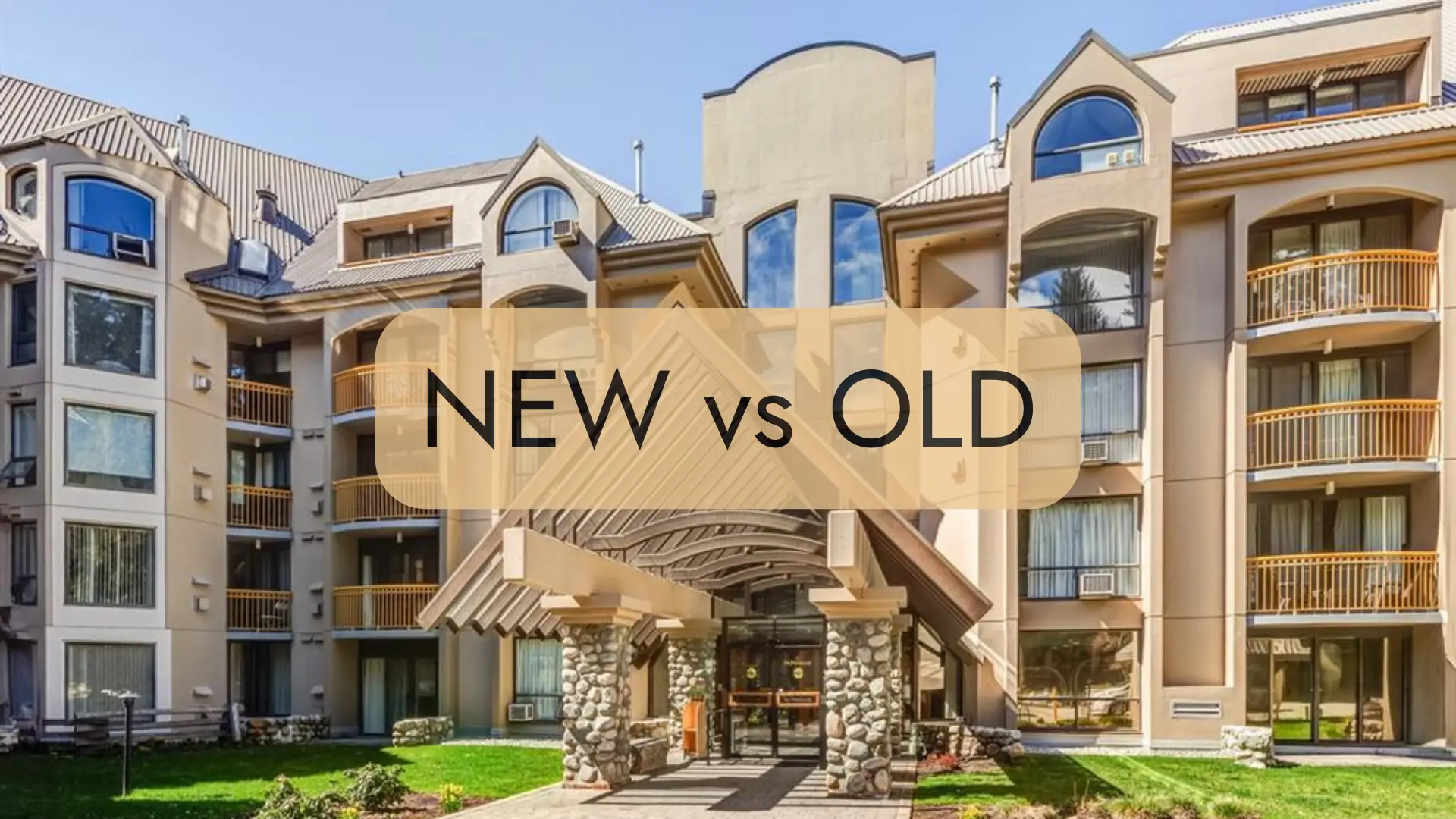
Let’s compare older or newer Whistler condos for sale. Look at strata fees, special assessments, renovations, rental zoning & resale value before you buy.
Roughly half of Whistler’s housing stock went up between 1981 and 2000: 1,330 units in the 1980s and 1,425 in the 1990s, according to the Whistler Community Foundation’s Vital Signs data. So when you browse Whistler condos for sale, a large share of the buildings you will see date from the 1980s and 1990s, with relatively little built since 2010. Which is the better buy depends less on the build year and more on five factors: price, strata fee, reserve fund, zoning and the cost to bring the unit up to the standard renters and future buyers expect.
Table of Contents
Purchase price: what the age premium actually buys
Our condo vs house comparison puts most condos between $520,000 and $1.5 million, and our Village real estate guide notes entry-level Village units start around $750,000. The Greater Vancouver REALTORS benchmark for a Whistler condo was $603,600 in March 2026, then fell to $515,100 in April; benchmark, median and average figures differ widely, so compare like with like when judging a price.
Location and rental zoning drive Whistler prices more than build date. An early-1990s Benchlands townhome in our current inventory, 31–4636 Blackcomb Way (built 1992, listed at $2,066,400 for 1,148 sq. ft.), already commands about $1,800 per square foot on the strength of its Benchlands location and Phase 1 nightly rental rights. New construction bought from a builder also attracts GST; the Canada Revenue Agency’s new housing rebate is available only to individual buyers who meet its conditions, so confirm the tax treatment with your accountant.
Strata fees and special assessments: where older buildings bite
Village condos typically run $400 to $800 a month in strata fees, and the strata townhomes we currently list carry fees between $515 and $867, higher where hotel-style amenities or utilities are bundled.
Newer buildings are not automatically cheaper to run, but they usually avoid the deferred capital backlog: roofs, decks and siding reaching end of life together in a 1980s or 1990s building. When that backlog exceeds the reserve, owners get a special assessment.
British Columbia tightened the rules in 2023. Stratas must now put at least 10% of the annual operating budget into the contingency reserve fund each year, and depreciation reports are mandatory every five years for stratas with five or more lots, with the old three-quarter-vote deferral removed. The report covers a 30-year horizon and is being phased in by region, so check whether the building has a current one and what it says is due. A 1992 building with a healthy reserve and completed envelope work can be a safer purchase than a 2015 building whose first report has just flagged a problem.
The Form B Information Certificate discloses the reserve balance, approved or proposed levies, two years of minutes and the latest depreciation report. We explain how to read these in our guide to reading Whistler listings and in 5 Red Flags Hiding in Whistler Real Estate Listings.
Building condition: the leaky-condo era reached Whistler
Much of coastal BC’s late-1980s to late-1990s wood-frame construction used face-sealed walls without a rainscreen, the flaw behind the province’s leaky-condo crisis. Whistler’s 1990s building wave, and the tail end of its 1980s wave, overlap that window, and snow and moisture management are recurring issues in older Whistler buildings. One BC strata management firm puts BC envelope remediation at roughly $25,000 to $80,000 per unit, with whole-building projects running $500,000 to more than $2 million over 12 to 24 months.
That does not make older Whistler condos a bad buy. Some older buildings will already have completed envelope or roof work; the depreciation report and minutes show whether that cost has been paid or is still ahead. The question is not “how old is it?” but “what has been replaced, when, and what is left on the depreciation report?” Our older-property checklist on moisture, snow management and permit history applies to strata buildings too.
Renovation costs: closing the gap on older Whistler condos for sale
An older unit’s interior is where buyers most often look to close the gap with newer stock. Check the strata’s renovation bylaws in the Form B before planning any work, and build in lead time and a contingency.
Kitchens and bathrooms are the obvious candidates; The Economics of a Whistler Cottage covers which renovations tend to improve value and rental appeal. Get contractor quotes before you write an offer, priced separately from any common-property work the strata still faces. Part of our post-purchase service is contractor referrals, so out-of-town owners are not managing a renovation blind from Toronto or Seattle. If you are buying from abroad, our guide for global buyers explains how we handle virtual showings and remote negotiations.
Rental potential and zoning: the factor that overrides age
In Whistler, nightly rental rights attach to zoning and covenants, not age. Phase 1 properties allow nightly or monthly rentals through a platform or manager with flexible personal use; Phase 2 hotel-condo units sit in a managed rental pool and cap personal use at 28 days in winter and 28 in summer, as we explain in Can You Rent Out Your Whistler Property?. For any property without one of those covenants, confirm nightly-rental permission with the seller’s documents and the Resort Municipality of Whistler before you rely on rental income.
Several of our current 1990s-built listings, including 31–4636 Blackcomb Way, carry Phase 1 nightly rental rights, so build year alone tells you nothing about income potential. Our vacation home economics article works through a realistic net: a typical Whistler host grosses around CA$79,000, but strata, management at roughly 25%, taxes and maintenance come off first.
Long-term resale value
Resale in Whistler rewards scarcity. Only 590 units were added from 2011 to 2021, so a well-located older unit with a Phase 1 covenant that travels with it is not easily replaced. No data we have breaks Whistler resale performance down by building age, so judge each unit on location, rental rights and how much capital work is still ahead in the depreciation report. The weakest resale position is an older unit in a building that has not done its capital work; buyers now read depreciation reports, and a looming envelope project gets priced into offers.
So which is the better value?
- Choose older if you want nightly rental zoning and a central location, and will verify the building’s capital history and renovate the interior. Provided the Form B checks out, this is where most of the value in Whistler condos for sale sits.
- Choose newer if you prioritize predictable costs, modern construction and full-time living, accept GST on the purchase and do not depend on short-term rental income.
- Walk away from any unit, of any age, where the reserve is thin, the depreciation report is missing or the minutes mention an envelope study without a funded plan.
If the Whistler numbers do not work, Squamish and Pemberton offer lower entry prices and more space, with different rental rules. Andrew King brings over 20 years of experience and $1.5 billion in transactions to this due diligence; our Seasonal Investor Guide covers the areas currently producing the strongest returns. Browse current Whistler condos for sale or contact Andrew to have the Form B, depreciation report and rental zoning pulled on any building before you write an offer.
Frequently asked questions
Are older Whistler condos cheaper to own than newer ones?
Not necessarily. Older buildings can carry more capital-repair exposure, so the reserve fund balance, the depreciation report and whether envelope and roof work is complete decide the real cost of older Whistler condos for sale.
Can I rent a newer Whistler condo nightly?
Only if it carries a Phase 1 or Phase 2 covenant. Age is irrelevant; confirm the covenant and zoning with the strata and the Resort Municipality of Whistler before buying.
What documents should I review before buying any Whistler condo?
The Form B Information Certificate, the latest depreciation report, two years of strata minutes, the current budget and reserve balance, the rental and renovation bylaws, and the strata’s insurance summary.