
Compare homes for sale in Squamish with Whistler properties by price, space, lifestyle, rental potential, total ownership costs, and your long-term goals.
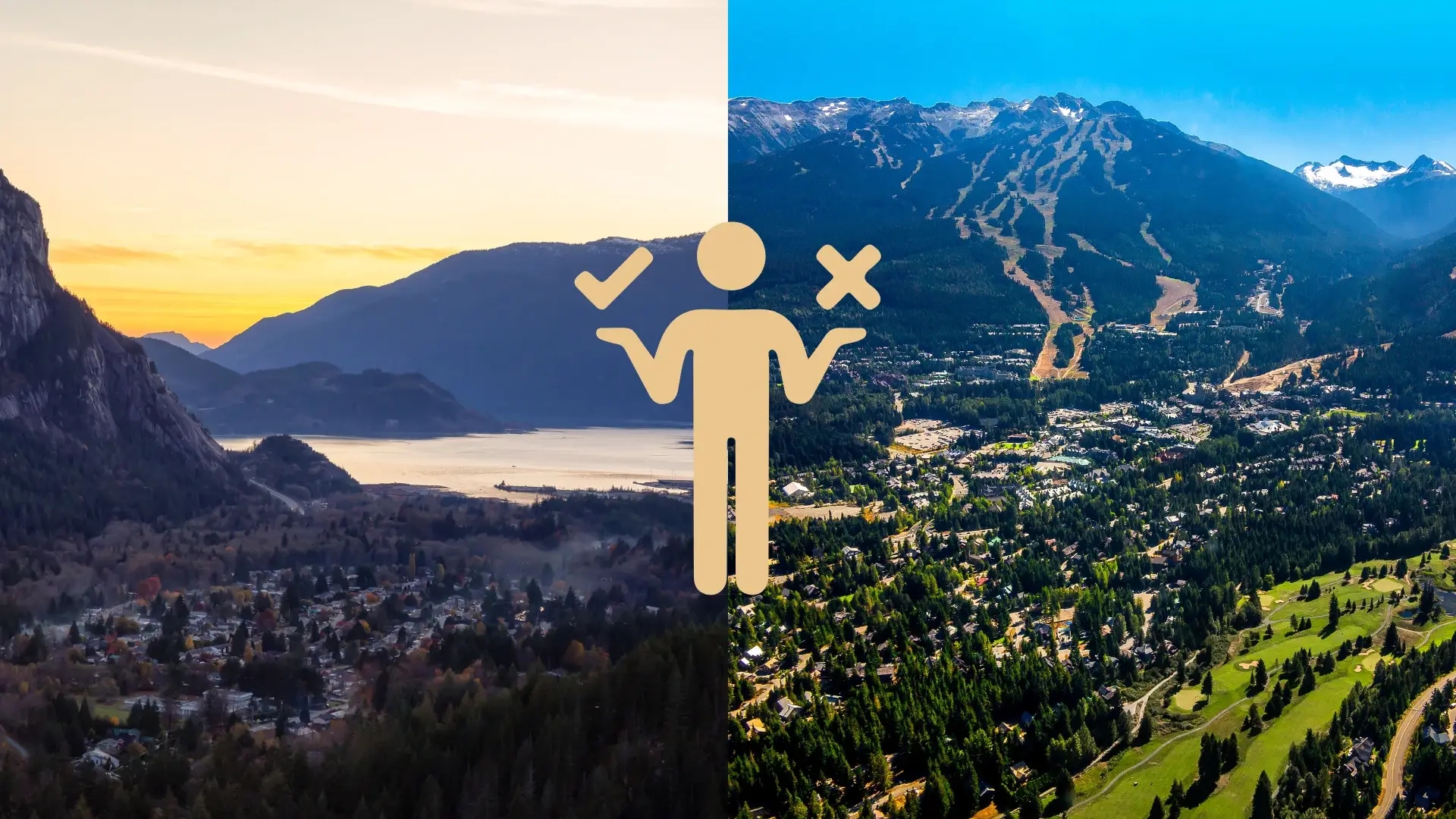
Two towns sit along the Sea to Sky Highway, and they offer very different versions of mountain living. Squamish is a growing town built around access, outdoor recreation, and everyday community life. Whistler is a globally recognized resort destination with skiing, dining, and a name people know worldwide.
So which gives you better value? The answer depends on what you want from a property, not just the price tag. This post compares price, lifestyle, property types, investment potential, carrying costs, and buyer fit across both markets. And at Whistler Spaces, we help buyers weigh both options with local knowledge across Whistler, Squamish, and Pemberton.
Table of Contents
What Does “Better Value” Really Mean in the Sea to Sky Market?
Better value in the Sea to Sky market means finding the property that best balances price, lifestyle, long-term growth, and personal use rather than simply choosing the cheaper home. As we put it in our market comparison, the decision “isn’t just about square footage or price per square foot.” It’s about how you plan to use the property.
Value comes down to a mix of factors:
- Purchase price and entry point
- Usable indoor and outdoor space
- Lifestyle fit for daily life or vacation use
- Resale and long-term growth potential
- Rental flexibility under local rules
- Commute and access needs
A full-time resident defines value differently from a vacation buyer or investor. Squamish often gives you more space and practicality. Whistler gives you resort prestige and scarcity.
How Do Homes for Sale in Squamish Compare With Whistler Prices?
The homes for sale in Squamish typically offer more space and a lower entry price than comparable Whistler properties, while Whistler commands a premium for its resort location and global demand. We’re clear that Whistler real estate commands resort-market pricing, with benchmark detached homes far above Squamish equivalents.
Whistler’s premium comes from limited land, steady tourism, and international appeal. Squamish leans toward townhomes, detached homes, and newer developments. Whistler runs more resort-oriented, from ski-in/ski-out condos to chalets and vacation properties.
Pricing shifts month to month in both towns, so review current listings with a local advisor before drawing conclusions.
Entry-level opportunities
Squamish tends to offer more accessible options for permanent residences and larger homes. We describe Squamish as offering an entry point into homeownership without sacrificing lifestyle quality. In Whistler, entry-level usually means a smaller condo, and we call a condo the more accessible entry point there, with zoning considerations attached.
Space and property type differences
Squamish neighbourhoods like Garibaldi Highlands offer mature single-family homes on large lots with easy trail access. Think garages, storage, and family-friendly layouts. Whistler properties often trade space for location, walkability to lifts, or rental appeal.
Which Location Offers the Better Lifestyle for Your Needs?
The homes for sale in Squamish usually offers stronger everyday lifestyle value, while Whistler offers stronger resort lifestyle value for buyers who prioritize skiing, tourism amenities, and vacation use. We frame it directly: Whistler is a purpose-built resort municipality, while Squamish is “a growing residential town with serious outdoor credentials.”
Squamish as a full-time community
Squamish suits commuters, young families, remote workers, and outdoor enthusiasts. It has a walkable downtown with cafes, a brewery scene, farmers’ markets, and expanding schools and services. And it sits roughly halfway between Vancouver and Whistler, which makes it work for many lifestyles.
Whistler as a resort destination
Whistler works best for buyers whose lives centre on the resort. The village offers fine dining, boutique shops, spas, and year-round events, plus Whistler Blackcomb’s 8,171 acres. But peak seasons bring crowds, so full-time residents often pick quieter pockets away from the tourist core.
Which Market Has Stronger Investment Potential?
Whistler may offer stronger resort-driven rental and scarcity value, while the homes for sale in Squamish may offer stronger growth-oriented value for buyers focused on long-term appreciation and lower carrying costs. Our Whistler real estate page calls the town a “trophy asset with long-term appreciation potential,” driven by limited land and steady tourism.
Squamish’s appeal is growth-based. Our Squamish real estate page points to consistent value growth, limited developable land, and a rising tech and remote-work base. Our Seasonal Investor Guide is a useful resource for weighing market timing and investor considerations.
Rental income considerations
Rental potential varies by zoning and property type. In Whistler, Phase 1 properties allow nightly and long-term rentals, Phase 2 units restrict owner use to about 56 days a year, and residential zones ban nightly rentals entirely. Squamish limits short-term rentals to principal residences, but its long-term market is tight, with vacancy well under 1%. Get local advice before assuming any rental income.
Long-term appreciation drivers
Whistler’s value rests on limited supply and destination status. Squamish’s value rests on population growth, its location between two hubs, and an expanding buyer base. Neither is a guarantee, but both markets have outperformed Metro Vancouver in recent assessments.
What Hidden Costs Should Buyers Compare Before Choosing?
Buyers should compare the full cost of ownership, including taxes, strata fees, insurance, maintenance, rental management, and travel expenses, because the lowest purchase price is not always the lowest-cost property. We stress that the listing price is only the starting point.
Strata and maintenance costs
Condo and townhome strata fees fund shared maintenance, building insurance, and reserves. Detached homes skip strata fees but need direct budgeting, and in high-snowfall areas we suggest setting aside 1% to 2% of property value each year for upkeep. Watch drainage, snow, and shaded driveways when looking at homes for sale in Squamish too.
Vacation property expenses
Second-home buyers should factor in furnishing, cleaning, management fees, vacancy periods, and wear from renters. As our condo-vs-house guide notes, the total annual carrying cost is what decides whether an investment actually works.
Who Is Better Suited to Buy in Squamish?
When looking at the homes for sale in Squamish, it is often better suited to buyers who want more space, stronger everyday practicality, easier access to Vancouver, and a lower entry point into the Sea to Sky market. It’s the stronger choice for most full-time buyers, backed by schools, healthcare, services, and a workable commute.
Best-fit buyer profiles
- Families wanting good schools and outdoor space
- First-time buyers priced out of the city
- Vancouver commuters and remote workers
- Outdoor recreation buyers
- Investors watching a fast-growing market
Generic buyer scenario
Consider a family choosing between a smaller Whistler condo and a larger Squamish townhome at a similar price. The homes for sale in Squamish often offer more square footage, a garage, and trail access minutes from home. That’s the trade-off in action.
Who Is Better Suited to Buy in Whistler?
Whistler is often better suited to buyers who prioritize resort access, ski culture, international appeal, and vacation or luxury property ownership over maximum square footage. For a second home with global name recognition, Whistler real estate is hard to beat.
Best-fit buyer profiles
- Vacation-home and ski-focused buyers
- Luxury purchasers
- International buyers, since Whistler is exempt from Canada’s foreign buyer ban
- Investors seeking resort rental demand
- Buyers wanting ski-in/ski-out or village walkability
When the premium makes sense
The premium works when you use the resort heavily, rely on legal nightly rentals, or value scarcity and prestige. As we put it, if your goal is a ski-season family base with rental income covering carrying costs, Whistler’s premium can be justified.
How Can a Local Real Estate Advisor Help You Compare Both Markets?
A local real estate advisor can help you compare current listings, neighbourhoods, zoning, rental rules, and long-term value so you choose the market that fits your goals. The mechanics of each market differ, so get local advice before assuming either works the way you expect.
Local market interpretation
Andrew King brings over 20 years across the Sea to Sky corridor and more than $1.5 billion in transactions. That experience helps you read beyond listing prices, interpret market movement, and avoid a mismatched purchase.
Personalized buying strategy
We help local buyers, international purchasers, investors, vacation seekers, and permanent residents line up budget, financing, intended use, and timing. Explore our Squamish Real Estate and Whistler Real Estate pages, or contact us for a personalized comparison.
Frequently Asked Questions
Is homes for sale in Squamish cheaper than Whistler?
Squamish is generally more affordable than Whistler, with lower entry points for both condos and detached homes. Pricing still depends on property type, neighbourhood, size, and current market conditions.
Can you commute from Squamish to Whistler?
Many people travel between the two towns, with the drive taking roughly 45 minutes in good conditions. Consider weather, road closures, work schedules, and lifestyle needs before relying on the commute.
Are Whistler properties harder to buy as a non-local buyer?
Non-local and international buyers can purchase in Whistler, which is exempt from Canada’s foreign buyer ban. Get advice on financing, taxes, ownership rules, and local market expectations before you buy.
Is Squamish a good place to buy a family home?
Squamish can be a strong option for families, with more space, outdoor access, and good schools. Areas like Garibaldi Highlands and Brackendale suit buyers wanting long-term livability.
Should I buy before ski season or wait?
Timing depends on inventory, competition, financing readiness, and your goals. Review seasonal inventory patterns with a local advisor before deciding.
Making the Right Sea to Sky Move
Squamish often provides better practical value and space, while Whistler provides better resort value, prestige, and vacation appeal. The right choice depends on your lifestyle, budget, property use, and investment goals. Neither market is objectively better.
If you’re weighing out homes for sale in Squamish against Whistler options, connect with Whistler Spaces for a personalized comparison led by Andrew King and the team. We’ll help you find the property that fits your goals across the Sea to Sky corridor.